The Ultimate Guide to the Jambay Lhakhang Drup Festival Tour in Bhutan
July 1, 2026
11 min read min read
Share:
If you are looking for a travel experience that completely breaks the mold of standard vacations, then planning a Jambay Lhakhang Drup Festival Tour in Bhutan should be at the very top of your bucket list.Deep in the tranquil valleys of Bumthang, which is widely celebrated as the spiritual heartland of the country, this iconic four-day festival brings centuries-old Buddhist mysticism directly to life through dramatic rituals and masked dances.For travelers seeking true cultural depth, this is not a staged show for tourists; it is a profound, living tradition where local communities gather in their finest hand-woven attire to receive blessings and purify negative karma.At Orrog, we specialize in crafting immersive, seamless journeys that allow you to witness these sacred events while respecting local traditions and enjoying absolute comfort throughout your exploration of the Himalayan Kingdom. The Ultimate Guide to the Jambay Lhakhang Drup Festival Tour in Bhutan.
The festival itself is an unforgettable sensory experience, balancing intense nighttime fire rituals with daytime cultural spectacles that paint the ancient stone courtyard in brilliant shades of silk brocade.Because this celebration takes place during the absolute peak of the autumn travel season, understanding the logistics, cultural expectations, and history of the event is essential for any traveler looking to make the journey.From the legendary foundations of the temple to the practicalities of securing visas and domestic flights, this comprehensive guide covers everything you need to know before booking your ultimate cultural holiday with a premium operator like Orrog.
The Sacred Origins of Jambay Lhakhang
To truly appreciate the energy of the festival, you first have to understand the ground you are standing on. Jambay Lhakhang is not just another monastery; it is one of the two oldest Buddhist temples in Bhutan, dating back all the way to the 7th century.
According to ancient Himalayan legend, the Tibetan Emperor Songtsen Gampo faced a massive spiritual obstacle when trying to introduce Buddhism across the region. A colossal, malevolent demoness lay across the entire Himalayan landscape, actively blocking the spread of peaceful teachings.To pin her down and neutralize her power forever, the Emperor vowed to construct 108 temples across the mountains in a single, miraculous day.Jambay Lhakhang was built specifically to pin down her left knee, anchoring the valley in spiritual protection.
In the 8th century, the great master Guru Rinpoche visited and consecrated the temple grounds, infusing the site with an extra layer of sacred power.The annual Drup festival is held to simultaneously celebrate the original founding of this ancient sanctuary and honor the monumental contributions of Guru Rinpoche to the identity of Bhutan.Walking through the low-ceilinged galleries, listening to the soft murmur of turning prayer wheels, and seeing the glow of hundreds of butter lamps makes it immediately clear why this temple remains a core pillar of Himalayan faith.
Core Highlights of the Festival
The festival is an intense journey into the heart of esoteric esoteric practices. While daytime events feature standard regional dances, the primary events of the Jambay Lhakhang Drup are distinctly mysterious and can only be witnessed right here in Bumthang.
Mewang: The Fire Blessing Ceremony
The festival officially ignites on the very first evening with the Mewang, a dramatic fire ritual that draws massive crowds under the dark mountain sky.A massive archway built entirely from dry pine needles, straw, and branches is erected in the middle of the temple grounds and set completely ablaze, sending giant walls of fire roaring into the night.
In an incredible display of deep devotion, local monks, pilgrims, and residents run directly through the intense, crackling flames.This ritual is believed to burn away the accumulated bad karma of the past year, clear away spiritual obstacles, and grant physical protection.For female spectators, passing under the heat of the fire is also traditionally believed to bless them with fertility.The deep boom of traditional horns, the smell of burning pine, and the energy of the chanting crowd create an electrical atmosphere that stays with you long after the embers die down.
Tercham: The Mystical Midnight Naked Dance
Undoubtedly the most exclusive and talked-about event in the entire Himalayan Buddhist world is the Tercham, or the Dance of Treasure.Performed strictly at midnight on the opening night of the festival under the flickering light of traditional butter lamps, sixteen carefully selected local men enter the temple courtyard.They wear intricate, wrathful deity masks and have their faces wrapped in white cloth, but are otherwise entirely naked.
This dance traces its history back to the 14th-century treasure discoverer Terton Dorji Lingpa.It is not a performance of immodesty; rather, it is a highly serious, deeply esoteric ritual intended to summon protective deities, purify the land, and ward off evil spirits that try to disrupt the religious ceremonies.The dancers undergo rigorous spiritual purification rituals beforehand, including bathing in water infused with sacred incense and maintaining strict celibacy.Because of the intense sanctity of the Tercham, photography, filming, and recording of any kind are completely and strictly forbidden during this midnight window out of respect for the local community.
The Day Chams: Stories in Motion
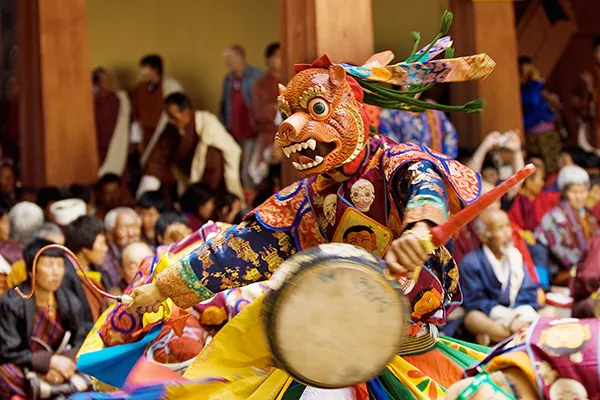
Once the sun rises over the ridges of Bumthang, the ancient stone courtyard transforms into a vibrant, spinning display of color for the daytime Cham dances.Monks and trained laymen dress up in heavy, spectacular silk brocade robes and hand-carved wooden masks to perform intricate, rhythmic dances accompanied by cymbals, drums, and long-horns.
Every single dance holds a specific moral lesson or mythological narrative.The Black Hat Dance (Shana Cham) features dancers in wide-brimmed hats who cut through negative energies and claim the physical space for cosmic good.The Dance of the Lords of the Cremation Grounds (Durdag Cham) uses striking, stylized skeleton masks to serve as a visual reminder of the absolute impermanence of human life.Watching these synchronized, looping dances offers a rare glimpse into how complex Buddhist philosophy is preserved and taught across generations.
When to Go: Understanding the 2026 Dates
Bhutanese festivals are tied directly to the lunar calendar, meaning the specific dates shift slightly every year on the standard solar calendar.For travelers planning ahead, the specific window for the upcoming festival is firmly set.Mark your calendars carefully for October 26 to October 29, 2026.
Choosing to book a tour during this late October window gives you some of the finest travel conditions available anywhere in the Himalayas.The summer monsoon rains have completely cleared out, leaving behind incredibly crisp, clean air and bright blue skies.The mountain visibility during late autumn is exceptionally sharp, making it an absolute paradise for landscape photographers.
Daytime temperatures in Bumthang during this stretch are highly comfortable, usually hovering around 15 to 18 degrees Celsius, making it perfect for wandering around the temples and taking valley walks.However, because of the high elevation of central Bhutan, temperatures drop rapidly the moment the sun dips behind the mountain ridges, often falling close to freezing at night.Packing heavy layers, high-quality thermal underwear, and fleece jackets is an absolute necessity for enjoying the late-night and midnight outdoor ceremonies comfortably.
How to Get to Bumthang
Reaching the spiritual core of Bhutan requires a bit of strategic planning, as Bumthang is located in the central region of the country, far removed from the primary international gateway airport in Paro.Travelers generally have two primary options for structuring their route, and our team handles all the details for whichever path you prefer.
Option 1: The Domestic Fly-In (Fast & Convenient)
The most efficient route to central Bhutan is taking a domestic flight from Paro International Airport directly to Yonphula or Bathpalathang Airport in Bumthang.This short, spectacular flight takes less than 35 minutes and glides directly over snow-capped Himalayan peaks, saving you two full days of mountain driving.Because these domestic planes are small and flights operate less frequently, seats during the peak festival season sell out months in advance.Booking early ensures you secure these coveted tickets without hassle.
Option 2: The Overland Trans-Bhutan Arc (Scenic & Immersive)
For travelers who want to truly absorb the changing landscapes, an overland road trip from the western valleys to the center is unmatched.This route takes you from Paro through the capital city of Thimphu, over the breathtaking Dochu La Pass at 3,100 meters, down into the warm valleys of Punakha, and across the high-altitude meadows of Gangtey before arriving in Bumthang.
While the winding mountain roads require patience and careful pacing, driving allows you to witness the true diversity of rural Bhutanese life, passing dense rhododendron forests, ancient cliffside dzongs, and terraced rice fields.Many travelers choose a hybrid approach: driving overland on the way into the country to acclimatize to the altitude and taking a domestic flight back to Paro at the end of their festival tour.
Crucial Cultural Etiquette for Travelers
The Jambay Lhakhang Drup is first and foremost a deeply sacred religious gathering, not an amusement park or a staged performance.Behaving with respect ensures that these fragile traditions remain welcoming to outside visitors for years to come.
Dress Appropriately: Both men and women must wear modest clothing that fully covers the shoulders and knees. Long pants, collared shirts, or traditional local attire are highly appreciated. Avoid hats, shorts, tank tops, or sandals when inside the temple gates.
Strict Photography Rules: You are welcome to take photos in the open daytime courtyard during the standard Cham dances, but always show respect and avoid blocking the view of local attendees.Photography, filming, or phone recording is absolutely prohibited inside the inner temple sanctuaries and during the entire midnight naked dance.
Circumambulate Correctly: Whenever you walk around a stupa, chorten, or the temple walls, always walk in a clockwise direction. This is a fundamental sign of respect in Buddhist tradition.
Interact Mindfully: The people of Bumthang are incredibly warm, hospitable, and open to sharing their culture.Always ask for polite permission before taking close-up portraits of village elders, children, or monks.
Why Book Your Festival Tour with Orrog?
Planning a trip to Bhutan during its busiest cultural window requires expert coordination to navigate strict regional regulations, daily sustainable development fees, and limited luxury accommodations. At Orrog, we are a leading Bhutan tour and travel company dedicated to providing seamless, immersive, and unforgettable custom travel experiences.
We take care of every moving part of your journey, from managing your visa processing and securing early domestic flight tickets to providing top-tier local guides who can translate the complex symbolism of the masked dances in real time.Our itineraries are carefully paced to ensure proper altitude adjustment, and we match your festival hours with stays in the finest comfortable lodges in the Bumthang valley.
Ready to secure your spot for the magical 2026 festival season? Get in touch with our travel design specialists today to build your customized journey:
What is the primary significance of the Jambay Lhakhang Drup Festival?
The festival commemorates the establishment of the 7th-century Jambay Lhakhang temple by Tibetan Emperor Songtsen Gampo and honors the 8th-century saint Guru Rinpoche, who brought tantric Buddhism to Bhutan.It is a vital spiritual event designed to purify bad karma, bless the land, and protect the community from negative forces.
Why is photography banned during the midnight naked dance?
The Tercham is a highly sacred, esoteric religious ritual meant to invoke protective deities and ensure fertility for the valley. It is performed with pure spiritual intent, not for entertainment. Banning cameras and recording devices preserves the sanctity, dignity, and privacy of the ritual and the local community.
How cold does it get in Bumthang during the late autumn festival season?
While late October days are usually bright, clear, and comfortably warm (averaging 15°C to 18°C), the high elevation means temperatures drop sharply once the sun sets.Nighttime temperatures regularly fall near freezing, so packing high-quality winter layers and thermal wear is essential for the outdoor night events.
Is a visa required to visit Bhutan for the festival tour?
Yes, all international tourists (except for citizens of a few regional South Asian countries with specific arrangements) require a pre-arranged visa to enter Bhutan. This visa is processed through licensed local tour operators like Orrog as part of a fully pre-booked travel itinerary.
How far in advance should I book my festival tour package?
Because the Jambay Lhakhang Drup is one of the most famous and unique festivals in Asia, hotel capacity in Bumthang and seats on domestic flights sell out exceptionally fast.It is highly recommended to secure your booking at least 5 to 6 months in advance to ensure smooth travel logistics. The Ultimate Guide to the Jambay Lhakhang Drup Festival Tour in Bhutan.