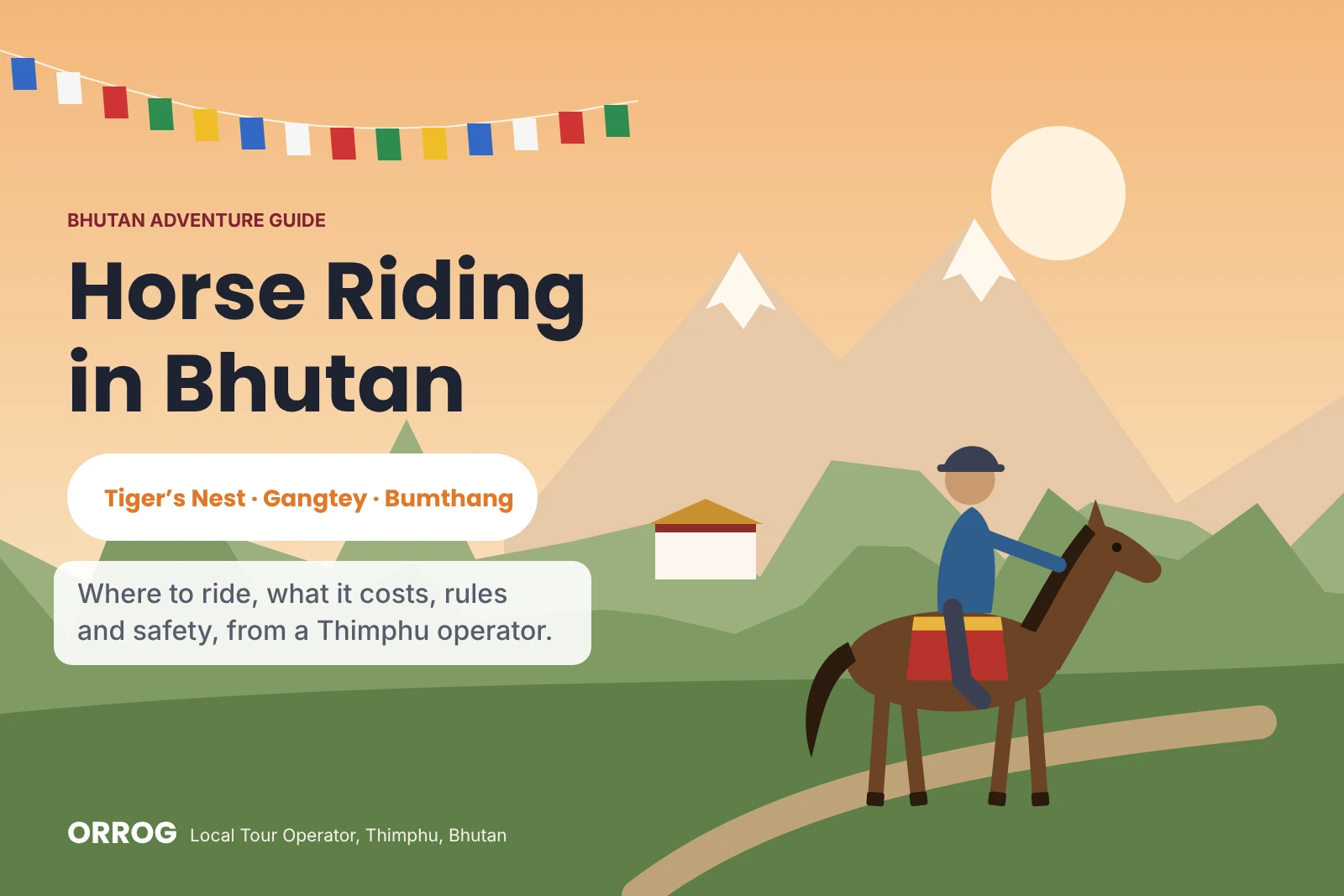
Horse riding in Bhutan is less about speed and more about getting somewhere beautiful at a calm, steady pace. For centuries, horses were how Bhutanese families moved between villages and carried goods over mountain passes. Today travellers can ride them up the trail to Tiger's Nest, across the meadows of the Phobjikha valley, or along forest paths in Bumthang.
We are a licensed tour operator in Thimphu, and "should I take a pony up to Tiger's Nest?" is one of the most common questions travellers ask before the hike. This guide covers every way to ride, what each option costs, who can ride, and how to stay safe.

Horse riding in Bhutan at a glance
| Question | Answer |
|---|---|
| Best-known ride | Pony up the Tiger's Nest trail, Paro |
| Tiger's Nest pony cost | About Nu. 700 to 1,000 one way, cash |
| Best places for real rides | Gangtey (Phobjikha), Tang Valley (Bumthang), Haa |
| Typical valley ride | About 2 hours, about USD 75 per person |
| Experience needed | None for gentle rides; handlers lead beginners |
| Rider limits at Bhutan's main ranch | 12 years and over, up to 90 kg |
| Best seasons | March to May and September to November |
| Main local breed | Yuta, about 97% of Bhutan's horses |
Six ways to go horse riding in Bhutan

| Ride | Where | What it involves | Approximate cost | Best for |
|---|---|---|---|---|
| Tiger's Nest pony | Paro | Car park to cafeteria, uphill only | Nu. 700 to 1,000 one way | Anyone who finds the climb hard |
| Valley ride | Gangtey, Phobjikha | About 2 hours at walking pace | About USD 75 per person | Beginners and families |
| Ranch day ride | Tang Valley, Bumthang | 4 to 5 hours on trails, with lunch | Ask the ranch or your operator | Beginners to intermediate riders |
| Village ride | Haa Valley | An afternoon or a full day | Ask your operator | A quiet, local experience |
| Horseback trek | Bumthang | 3 days, 4 to 6 hours a day, camping | Multi-day package | Confident riders |
| Watch a horse race | Laya, Royal Highland Festival | October festival in the highlands | Free to watch | Trekkers and festival lovers |
Tiger's Nest by horse: what you need to know

The hike to Paro Taktsang, or Tiger's Nest, climbs from a car park at about 2,600 metres to the monastery at about 3,120 metres. The round trip takes 4 to 6 hours. Ponies wait at the car park for anyone who wants help with the steepest first section.
- How far the pony goes: only to the Taktsang cafeteria, about halfway at roughly 2,940 metres. Ponies are not allowed on the upper trail, so everyone walks the rest, including the steps across the gorge to the monastery.
- Uphill only: ponies are for the climb. Riding down the steep trail is unsafe, so everyone walks back.
- Cost: about Nu. 700 to 1,000 (₹700 to ₹1,000) one way, according to Byways and other recent guides. Pay in cash at the car park.
- Booking: ponies are first come, first served at the trailhead. Arrive early in peak season.
- Time: about 1 to 1.5 hours to the cafeteria, then 1.5 to 2.5 hours more on foot to the monastery.
Should you take one? A pony makes sense if you have knee trouble, are older, or are worried about the altitude, because the first section is the steepest. It reduces the effort but does not remove it: the walk from the cafeteria still climbs about 180 metres, then drops into the gorge and climbs again. If you are reasonably fit, walking the whole way is part of the experience. Our Tiger's Nest hike includes a guide who sets an easy pace.
Horse riding in Gangtey (Phobjikha valley)
The wide glacial valley of Phobjikha, at about 3,000 metres, is the easiest place in Bhutan for a proper ride. A classic programme lasts about two hours at walking pace through meadows, pine forest and villages, with views of Gangtey Monastery. Experienced riders may trot briefly.
Druk Asia lists the ride at about USD 75 per person, including a suitable horse, a helmet, a local handler and a short introduction to riding. No experience is needed, and handlers lead the horse for children and nervous riders. It must be arranged in advance. In winter you may see the black-necked cranes that roost in the valley.
Phobjikha fits well into a western Bhutan trip. See our Phobjikha Valley and Gangtey Trek and our Black-Necked Crane Tour.
Horse riding in Bumthang
Bumthang, in central Bhutan, is the country's riding heartland. Wind Horse Ranch opened in the Tang Valley in 2012 with an outdoor arena and quiet trails, and later added a second ranch in Gangtey.
| Bumthang ride | Time | Level |
|---|---|---|
| Ogyen Choling Manor and museum | About 4 to 5 hours | Beginner |
| Tandingang village via a cattle farm | About 4 to 5 hours | Beginner |
| Phephe La pass and an ancient stupa | About 5 hours | Intermediate to advanced |
| Bushman Trail, Chamkhar valley views | 5 hours or more | Intermediate to advanced |
| 3-day horseback trek: Tang to Kunzangdrak, Padselling and Dorjibi | 4 to 6 hours a day, camping | Confident riders |
Rides usually start with an arena lesson. The ranch's horses are local Yueta (Yuta) horses, 12 to 15 hands high, and its limits are riders aged 12 and over weighing up to 90 kg. On steep or rocky ground you may be asked to dismount and walk beside your horse.
Bumthang is a long drive or a short domestic flight from Paro. Our Bumthang Valley tour is the easiest way to add a ride.
Horse riding in Haa and other valleys
MyBhutan lists the Haa Valley alongside Phobjikha and Tang as a popular starting point for rides, from an afternoon to several days. Haa is one of the quietest valleys in western Bhutan and is only a few hours from Paro. Our Haa Valley tour can include a village ride. Riding as a tourist activity has only grown in recent years, so in smaller valleys a ride is usually arranged with local families through your operator rather than booked at a stable.
How long will you be in the saddle?

If you have never ridden, start short. Two hours in Gangtey is comfortable for most beginners. A 4 to 5 hour day ride in Bumthang is fine if you have ridden a little before, and the 3-day horseback trek adds up to 15 to 17 hours in the saddle, which is best for confident riders.
Horses on Bhutan's treks
On most multi-day treks, you walk and horses carry the load. Horses and mules carry tents, kitchen equipment and duffel bags in the middle altitudes, and yaks take over above about 3,500 metres on high routes such as the Laya Gasa and Snowman treks. Trekkers carry only a daypack. If you would like a riding pony on standby for a long day, ask your operator whether one can be arranged for your route.
Our Druk Path Trek, Jomolhari Trek and Laya Gasa Trek are all supported by pack animals and local horsemen.
Bhutan's horses and horse culture

Bhutan has three traditional horse breeds, according to a 2018 study by the National Biodiversity Centre:
| Breed | Share of Bhutan's horses | Where | Notes |
|---|---|---|---|
| Yuta | About 97% | Across Bhutan | Bhutan's own breed, thought to be a stable cross of Tibetan and Indian types |
| Boeta | Fewer than 100 | Districts bordering Tibet | Introduced from Tibet in recent times |
| Sharta | Fewer than 100 | Districts bordering Arunachal Pradesh | Introduced from Arunachal Pradesh in recent times |
Horses were once central to Bhutan's economy: the same study notes that horse exports to Assam were a major source of income between 1907 and 1926. As roads have reached more villages, fewer horses are needed. The Ministry of Agriculture and Livestock counts 10,499 horses in 2024, down from 24,333 in 2006, and has launched an equine development strategy that names eco-tourism as one future role for Bhutan's horses.
Horse racing at the Royal Highland Festival. Every October, the highland village of Laya hosts the Royal Highland Festival, with horse races among the highlights. In the 8th edition, two brothers from Paro took first and second place, with the winner receiving his prize from His Majesty (The Bhutanese). Reaching Laya means a trek, so it suits adventurous travellers.
Is horse riding in Bhutan safe?

Horse riding safety tips for Bhutan: what to wear and how to ride on mountain trails
With a reputable operator, yes. Bhutanese horses are small, calm and sure-footed on mountain paths, rides are mostly at walking pace, and handlers stay with beginners. A few habits make it safer and more comfortable:
- Wear long trousers, closed flat-soled shoes, sunscreen, sunglasses and a light jacket. Carry a waist pouch rather than a backpack.
- Ask for a helmet and wear it. Druk Asia notes helmets are provided on Gangtey rides.
- Lean slightly forward going uphill and keep your back straight and relaxed.
- Hold the reins gently. Do not pull hard; small, soft movements are enough.
- Walk down at Tiger's Nest and dismount on steep or rocky sections when asked.
- Respect the limits. Weight and age limits protect both you and the horse.
- Check with a doctor first if you have back, hip or knee problems or are pregnant.
Riding at 2,600 to 3,000 metres is more tiring than at sea level, so drink water and take it slowly on your first days in Bhutan.
Best time for horse riding in Bhutan
| Season | Months | Riding conditions |
|---|---|---|
| Spring | March to May | Wildflowers and rhododendrons, mild days; one of the best seasons |
| Monsoon | June to August | Green but wet; trails get slippery |
| Autumn | September to November | Clear skies and firm trails; the best season |
| Winter | December to February | Cold at altitude but dry; cranes in Phobjikha |
For month-by-month weather, see our guide to the best time to visit Bhutan from India.
Planning a riding trip from India
Indian travellers need no visa, just a free entry permit and the Sustainable Development Fee of ₹1,200 per adult per night (see our SDF guide). The Tiger's Nest pony can be paid in rupees or ngultrum, since the two are at par. A guide is required beyond Thimphu and Paro, so rides in Gangtey, Bumthang and Haa are best arranged as part of a guided trip. Our guide to the Bhutan trip cost from India shows how to budget the rest, and families can start with our Bhutan family tours.
Frequently asked questions
Can you ride a horse up to Tiger's Nest?
Partly. Ponies take you from the car park to the cafeteria, about halfway up. You walk the rest of the way to the monastery, and the whole way down.
How much is a horse ride to Tiger's Nest?
About Nu. 700 to 1,000 (₹700 to ₹1,000) one way, paid in cash at the car park. Prices can change, so check with your guide.
Can you ride a horse down from Tiger's Nest?
No. Ponies are for the climb only, because riding down the steep trail is unsafe. Everyone walks back down.
Do I need riding experience to ride in Bhutan?
No, not for the Tiger's Nest pony or the gentle valley rides in Gangtey and Bumthang. Handlers lead beginners and give a short introduction. Multi-day horseback treks suit confident riders.
Is there a weight or age limit for horse riding in Bhutan?
It depends on the operator. Wind Horse Ranch, Bhutan's main riding ranch, accepts riders aged 12 and over weighing up to 90 kg. Gangtey rides welcome children, with handlers leading the horse.
Where is the best horse riding in Bhutan?
Gangtey in the Phobjikha valley is best for an easy 2-hour ride. The Tang Valley in Bumthang is best for longer day rides and multi-day horseback treks.
How much does horse riding in Gangtey cost?
About USD 75 per person for a 2-hour ride, including the horse, a helmet and a handler.
What breed are Bhutanese horses?
Mostly Yuta, Bhutan's native breed, which makes up about 97% of the country's horses. Small numbers of Boeta and Sharta horses live near the northern and eastern borders.
Is horse riding in Bhutan safe for children?
Yes, on gentle led rides such as in Gangtey, where handlers lead the horse. Some ranches set a minimum age for longer rides, such as 12 at Wind Horse Ranch.
When is the best time for horse riding in Bhutan?
Spring (March to May) and autumn (September to November), when trails are dry and the weather is mild. Avoid the monsoon months if you can.
Plan a Bhutan trip with horse riding
Orrog is a licensed local tour operator in Thimphu. We can add a Tiger's Nest pony, a Gangtey valley ride or a Bumthang trail ride to your Bhutan trip, and arrange permits, SDF, hotels, guide and vehicle around it. Tell us your dates, group size and riding experience, and we will send a full quote.
Chat with us on WhatsApp · Send an enquiry
Prices are approximate and set by local operators and horse owners; confirm them when you book. Riding involves some risk: follow your handler's instructions.