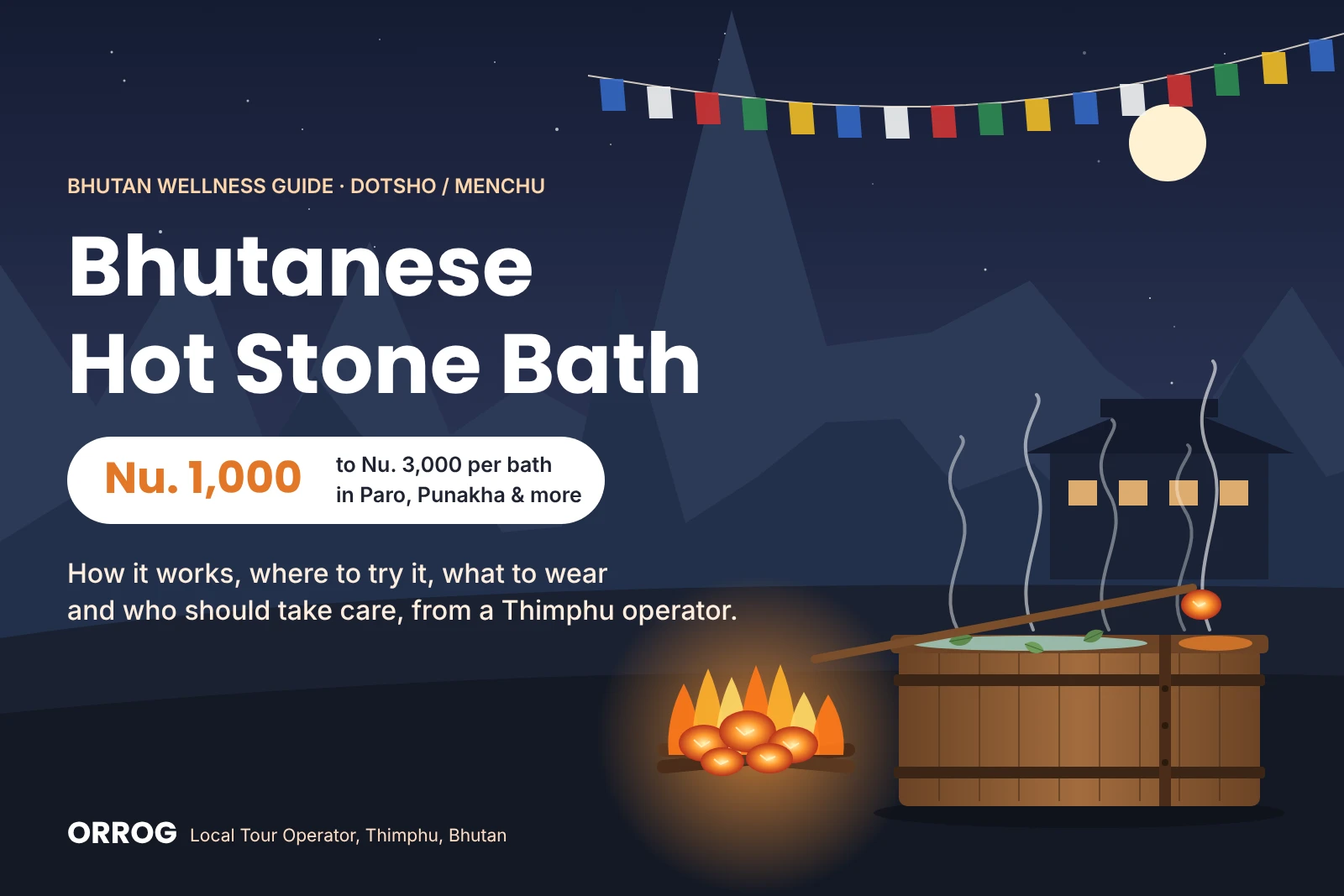
A hot stone bath in Bhutan is one of the simplest and most memorable things you can do on a trip here. You sit in a wooden tub of herb-scented water while river stones, roasted in a fire until they glow, hiss and crack in a compartment beside you. Bhutanese families have bathed this way for centuries, especially in winter, and many still do.
We are a licensed tour operator in Thimphu, and we regularly add hot stone baths to our guests' trips, from farmhouses in Paro to hotel bathhouses in Punakha. This guide explains how it works, what it costs, where to try it, what to wear and who should take care.

Bhutanese hot stone bath at a glance
| Question | Answer |
|---|---|
| Local names | Dotsho, menchu ("medicinal water") |
| How it is heated | River stones roasted in an open fire, dropped into a separate compartment |
| Main herb | Artemisia (wormwood), sometimes with other local herbs or flowers |
| Typical cost | About Nu. 1,000 to 3,000 per bath; Nu. 1 = ₹1 |
| How long | Plan for 60 to 90 minutes, soaking in rounds |
| Best areas | Paro, Punakha, Haa, Bumthang, Thimphu |
| Best season | Winter (November to February), but available all year |
| Booking | A day ahead, through your guide or tour operator |
What is a Bhutanese hot stone bath?
The hot stone bath is Bhutan's traditional way of soaking away cold and tiredness. Locally it is called dotsho, and it is also known as menchu, meaning "medicinal water". The word menchu is also used for natural medicinal springs, so do not be confused if you hear it in both contexts.
Traditionally the tub, called a wa, stood outside the farmhouse, in a garden shed or beside a river, where the best stones could be collected. Today you will find hot stone baths everywhere from village homes to five-star resorts.
A short history of the hot stone bath
According to Bhutan's Department of Tourism, bathing in medicinal waters has been part of Bhutanese culture for more than 13 centuries, dating back to at least the 7th century and shaped by Tibetan medicine and Indian Ayurveda. One ancient name for Bhutan is Menjong, "the land of medicinal herbs", and herbal bathing grew naturally out of that tradition.
Families would bathe once or twice a week, and more often in winter after the harvest. Some still consult an astrologer to choose an auspicious day. The Folk Heritage Museum in Thimphu, set in a restored farmhouse, keeps a traditional hot stone bath in its backyard and notes that it is enjoyed on special occasions such as Losar, the Bhutanese New Year.
How does a hot stone bath work?

How a Bhutanese hot stone bath works: stones heated in a fire, carried to the tub and dropped into a separate compartment
The process is simple, and watching it is half the experience.
- The stones are heated. Large, smooth river stones, roughly the size of a pomelo, are placed in an open fire for several hours until they glow red.
- They are carried to the tub. Your host lifts each stone with wooden tongs or a bar and drops it through a hatch or chute into a separate compartment at one end of the tub.
- The stones hiss and crack. As they hit the water they sizzle, split and heat the bath. Bhutanese tradition holds that they release minerals into the water.
- You soak in herbal water. The bathing side is filled with fresh water and leaves of Artemisia (wormwood). When the water cools, your host adds another hot stone.
The compartment is walled off with slatted wood, so the stones never touch you. Tell your host if you want it hotter or cooler; adjusting the heat is part of the ritual.
Which herbs are used?
The classic ingredient is Artemisia, known in English as wormwood, which gives the water a fresh, slightly bitter scent. Bhutan's Department of Tourism calls it the most archetypal ingredient of the bath. Some hosts add other local herbs, tree bark or wildflowers, and luxury hotels often scatter flowers on top. If you have sensitive skin or plant allergies, ask what has gone into the water before you get in.
Benefits: what Bhutanese people believe
In Bhutan the hot stone bath is valued as a traditional remedy. People use it for:
- Joint pain, arthritis and stiff muscles, especially after a trek or the Tiger's Nest hike
- Stomach complaints and some skin conditions
- General tiredness, stress and better sleep
These are traditional beliefs rather than proven medical effects, and there is little scientific research on the Bhutanese bath itself. What is well established is that a warm soak can ease sore muscles, help you relax and prepare you for sleep. Treat the bath as a relaxing cultural experience, not a treatment, and keep taking any medicine you have been prescribed.
Who should avoid a hot stone bath or take care?

Hot stone bath safety: who should avoid it or check with a doctor, and good habits for everyone
Few guides mention this, but it matters. A hot soak raises your body temperature and lowers your blood pressure, much like a hot tub or sauna. The Cleveland Clinic advises avoiding hot tubs, or asking a doctor first, if you:
- Are pregnant
- Have a heart condition, or high or low blood pressure
- Have epilepsy or a seizure disorder
- Have open wounds, a fresh tattoo or piercing, or have recently been unwell with fever or diarrhoea
- Are bringing children under 5
For everyone else, a few habits keep it comfortable:
- Soak in rounds of about 15 minutes, with breaks to cool down.
- Drink water before and after. At altitude you lose fluid faster than you expect.
- Save the ara (local rice spirit) for after the bath. Alcohol in hot water raises the risk of fainting.
- Keep your hands out of the stone compartment.
- Get out if you feel dizzy, overheated or get a headache, and stand up slowly.
Where to try a hot stone bath in Bhutan

Where to try a hot stone bath in Bhutan: farmhouses and homestays, local bathhouses and luxury hotel spas
You can try a hot stone bath in almost every valley on the main tourist route. Most travellers choose between three types.
| Place | Area | Type | What to expect |
|---|---|---|---|
| Aum Choden Homestay | Paro | Farmhouse homestay | A 108-year-old traditional house; archery and cooking demos too |
| Bjagoe Menchu | Paro, about 10 km from Bondey towards Chele La | Local bathhouse | In a community forest; popular with Bhutanese and good value |
| ZAnTA | Paro, on the Paro Chhu | Bathhouse | Natural spring water, organic meals, express foot bath |
| Punakha valley farmhouses | Punakha | Farmhouse | Baths among the rice fields, often with dinner |
| Dawakha village homestays | Haa | Homestay | Quiet, rural and very local |
| Sherab Dema Farmhouse | Bumthang, near Jambay Lhakhang | Farmhouse homestay | Ema datshi and ara served afterwards |
| Dangchu | Wangdue Phodrang | Village bathhouse with guesthouse | Locals stay for days |
| COMO Uma Paro and Uma Punakha | Paro, Punakha | Luxury hotel | Private bathhouse; COMO Uma Punakha's sits on the hillside above the hotel |
| Amankora Gangtey | Phobjikha | Luxury lodge | Bath in a farm shed with candles and mountain views |
| Terma Linca | Thimphu | Luxury resort | Riverside resort on the edge of the capital |
Paro is the easiest place for most visitors, because a bath fits neatly into the evening after the Tiger's Nest hike. Our Cultural Tour of Paro Valley can include one.
Punakha is warmer and lower, with farmhouses set among rice terraces. Our Punakha Valley tour already lists an optional hot stone bath on its first day.
Haa and Bumthang are best if you want a quieter, more local experience. See our Haa Valley and Bumthang Valley tours.

How much does a hot stone bath cost?
A hot stone bath at a farmhouse, homestay or local bathhouse costs about Nu. 1,000 to Nu. 3,000 per bath, according to Daily Bhutan. Because the ngultrum is pegged 1:1 to the Indian rupee, that is ₹1,000 to ₹3,000, and rupees are accepted across Bhutan.
| Type | Typical price | Usually includes |
|---|---|---|
| Local bathhouse | Lower end of Nu. 1,000 to 3,000 | Tub, stones, herbs |
| Farmhouse or homestay | Nu. 1,000 to 3,000 | Tub, stones, herbs; dinner often available for extra |
| Luxury hotel | Spa menu price, usually much higher | Private bathhouse, robes, tea; massage extra |
Prices vary with group size and whether a meal is included, so confirm when you book. If you travel with a tour operator, the bath can be added to your itinerary and shown on your quote.
What to expect, step by step
- Book a day ahead. The stones need hours in the fire, so hosts cannot prepare a bath on the spot. Your guide will arrange it.
- Arrive and change. Tubs are usually inside a small wooden bathhouse or covered with a tent or sliding bamboo door for privacy.
- Watch the stones go in. Ask to see the fire; it is the most photogenic part.
- Soak in rounds. Sit for 10 to 15 minutes, step out to cool down, then go back in. Call your host when you want another stone.
- Finish slowly. Many places follow the bath with tea or a meal, and hotels often add a salt scrub and oil massage.
What to wear
Wear swimwear. Men usually wear swim shorts; women wear a swimsuit, or a sports bra with shorts. Many places provide towels, but carry your own and warm clothes for afterwards, especially in winter.
Etiquette tips
- Rinse off before you get in if a tap is available.
- Ask before photographing your hosts or their home.
- Couples can usually share a tub; families with children should check tub size when booking.
- Leave the stone compartment to your host.
Hot stone bath vs hot spring (tsachu)

Bhutan also has natural hot springs, called tsachu. They are a different experience, and many visitors mix the two up.
| Hot stone bath (dotsho, menchu) | Hot spring (tsachu) | |
|---|---|---|
| Heat source | Fire-heated river stones | Natural geothermal water |
| Where | Farmhouses, homestays, hotels | Gasa, Gelephu, Chubu (Punakha), Duenmang (Zhemgang), Dur (Bumthang) |
| Access | Near your hotel in most valleys | Remote; some need a long drive, hike or trek |
| Cost | About Nu. 1,000 to 3,000 | Usually free |
| Privacy | Private tub | Shared pools |
| Best for | First-time visitors on any itinerary | Trekkers and slow travellers |
Gasa Tsachu is the best known; it lies near Gasa town on the route of our Laya Gasa trek. Locals traditionally visit hot springs in winter and spring and often stay for days. For most first trips, a hot stone bath is far easier to fit in.
When is the best time for a hot stone bath?
You can have a hot stone bath at any time of year, but it is best in winter, from November to February, when evenings in Paro and Bumthang are cold and the steam rises off the tub. It is also ideal:
- On the evening after the Tiger's Nest hike
- At the end of a trek, to ease stiff legs
- On a honeymoon; our Punakha Valley Honeymoon Retreat suits a private bath for two
If wellness is the main reason for your trip, look at our active and wellness tours, such as the Bhutan Spa and Wellness Trek.

Planning from India?
Indian travellers pay the Sustainable Development Fee of ₹1,200 per adult per night, and the bath itself can be paid in rupees. Our guide to the Bhutan SDF for Indians explains the fee, and if you are coming overland, see Bagdogra to Bhutan by road.
Frequently asked questions
What is a hot stone bath in Bhutan called?
It is called dotsho, and also menchu, which means "medicinal water". The wooden tub is called a wa.
How much does a hot stone bath cost in Bhutan?
About Nu. 1,000 to Nu. 3,000 per bath at farmhouses, homestays and local bathhouses, which is ₹1,000 to ₹3,000. Luxury hotels charge more.
How long does a hot stone bath last?
Plan for 60 to 90 minutes in total, soaking in rounds of about 15 minutes with breaks. COMO Uma hotels offer 90-minute sessions.
Do the hot stones touch you?
No. The stones sit in a separate compartment walled off with slatted wood, so they heat the water without touching you.
What should I wear for a hot stone bath?
Swimwear. Men usually wear swim shorts; women wear a swimsuit or a sports bra with shorts. Bring warm clothes for afterwards.
Where is the best hot stone bath in Bhutan?
For an authentic experience, a farmhouse in Paro, Punakha, Haa or Bumthang. For comfort, a luxury hotel such as COMO Uma Paro, COMO Uma Punakha or Amankora Gangtey.
Is a hot stone bath safe?
For most healthy adults, yes, if you soak in rounds and drink water. Pregnant travellers, people with heart conditions or blood pressure problems, and young children should avoid it or ask a doctor first.
Can you do a hot stone bath in summer?
Yes. Baths run all year, but they feel best in winter, from November to February.
What is the difference between a hot stone bath and a tsachu?
A hot stone bath is heated with fire-roasted stones in a private wooden tub. A tsachu is a natural hot spring, often in a remote valley, and usually free.
Do I need to book a hot stone bath in advance?
Yes. The stones need several hours in the fire, so book at least a day ahead through your guide or tour operator.
Book a hot stone bath with Orrog
Orrog is a licensed local tour operator in Thimphu. We add hot stone baths to any itinerary, at a farmhouse, a local bathhouse or your hotel, and arrange the permits, guide, vehicle and certified hotels around them. Tell us your dates and group size, and we will reply with a full quote.
Chat with us on WhatsApp · Send an enquiry
Prices are approximate and vary by host. Health information is general guidance, not medical advice; speak to your doctor if you have a medical condition. We review this page every quarter.