
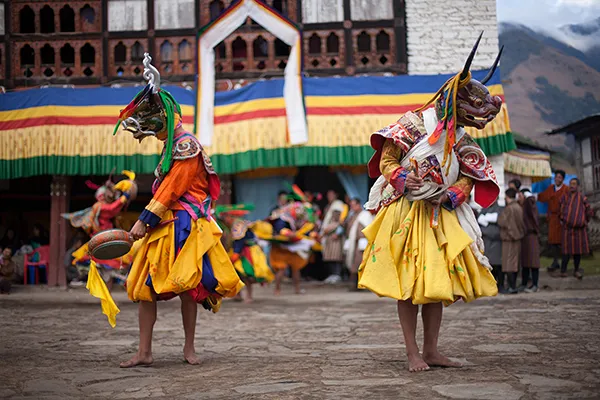
Bhutan holds few festivals as dramatic as the Punakha Drubchen and Tsechu. Set inside the fortress walls of Punakha Dzong, this event blends real history with sacred ritual. Warriors dressed in 17th-century armor reenact a famous battle. Monks perform masked dances that honor Guru Rinpoche. Together, these two festivals offer travelers a rare window into Bhutanese identity, faith, and memory. This guide explains what the Punakha Drubchen and Tsechu are, why they exist, and how to experience them.
Quick Facts About the Punakha Drubchen and Tsechu
- Location: Punakha Dzong, western Bhutan
- Origin: 1639, after an attempted Tibetan invasion
- Founder: Zhabdrung Ngawang Namgyal, the unifier of Bhutan
- Performers: Pazap warriors from the Wang region
- Timing: Late February or early March, based on the lunar calendar
- Combined duration: About six days for both festivals
- Highlights: Battle reenactment, Cham mask dances, and a giant thongdrel
What Is the Punakha Drubchen?
The Punakha Drubchen is a historical festival held in western Bhutan. It is also known as Punakha Dromche. Unlike most Bhutanese festivals, which focus purely on religion, this one recreates a real military event. Local men called Pazaps dress in 17th-century battle gear for the occasion.
They reenact the defense of Punakha against invading Tibetan forces. The festival honors Zhabdrung Ngawang Namgyal, the leader who unified Bhutan. It takes place every year in the courtyard of Punakha Dzong. Immediately after, the Punakha Tsechu begins, adding sacred mask dances and blessings.
The Historical Battle That Inspired the Festival
The Search for a Sacred Relic
In the early 17th century, Zhabdrung Ngawang Namgyal fled political conflict in Tibet. He carried with him a sacred relic called the Rangjung Kharsapani. Buddhists believe this self-created image represents Chenrezig, the deity of compassion. Tibetan authorities wanted the relic returned, along with Zhabdrung himself.
Their forces invaded Bhutan several times during this period. In 1639, one invasion force gathered near Punakha with clear intent. They hid on a hill called Jili Gang, watching the dzong below. Zhabdrung knew a direct battle would likely end badly for Bhutan.
A Victory Won Without a Real War
Rather than fight, Zhabdrung chose deception. He had almost no standing army available for defense. Instead, he called on young volunteers from the Wang region. These men, later known as Pazaps, gathered inside Punakha Dzong.
Zhabdrung ordered them to march out one gate each morning. Then they reentered through another gate that same evening. This trick made the invaders believe Bhutan held a massive force. When the Tibetan army still refused to leave, Zhabdrung tried another plan.
He staged a public ceremony beside the Mo Chhu river. Monks appeared to drop the sacred relic into the water. Convinced the relic was lost forever, the Tibetan forces withdrew. Bhutan won its victory without a single major clash. That same year, Zhabdrung established the Punakha Drubchen to mark the event.
The Pazap Warriors and Their Role
The heart of the Punakha Drubchen lies with the Pazap warriors. These are not professional soldiers or actors by trade. They are ordinary men chosen from eight village blocks near Punakha and Thimphu, an area known as Wang Tsochengye.
Centuries ago, Bhutan had no permanent national army. Communities instead sent able young men whenever danger arose. That same tradition continues today through the festival performance. Only men from these specific villages may take on the Pazap role.
Their costumes recreate 17th-century military dress in vivid detail. Each performer wears a patterned gho paired with a yellow silk skirt. Colorful ribbons decorate the skirt, adding movement during the performance. Felt boots in white, blue, and red complete the traditional look. Many Pazaps also carry swords and traditional shields, and their coordinated movements bring the old battle scenes to life.
Inside the Punakha Drubchen Reenactment
The Punakha Drubchen unfolds over several days inside the dzong courtyard. Each day builds toward the dramatic recreation of the historic battle. Pazap warriors march, chant, and perform mock combat with wooden swords. Their movements follow patterns passed down through many generations.
Monks from the central monastic body take part in the rituals. Together, they perform the Norbu Chushani ceremony beside the Mo Chhu river. This ritual reenacts the immersion of the sacred relic centuries ago. It reminds spectators how strategy, not bloodshed, secured victory for Bhutan.
On the final day, celebration replaces reenactment as the mood shifts. Triumphant generals are carried up the dzong stairs by their men. Crowds gather to watch, cheer, and take part in the festivities. Local villagers often travel far to witness this proud tradition. For many Bhutanese families, attending is both a duty and an honor.
The Punakha Tsechu: Sacred Dances and Blessings
As soon as the Drubchen ends, the Punakha Tsechu quickly begins. While the Drubchen focuses on history, the Tsechu centers on faith. Tsechu means the tenth day in the Dzongkha language. Traditionally, this day marks the birth anniversary of Guru Rinpoche.
Also called Padmasambhava, he introduced Tantric Buddhism to Bhutan long ago. Many Bhutanese honor him as a second Buddha figure. The Punakha Tsechu lasts about three days inside the dzong courtyard. It is one of the most anticipated religious events in the region.
How the Tsechu Differs from the Drubchen
The Punakha Drubchen is much older than the Punakha Tsechu. The Drubchen dates back to the original 1639 victory celebration. The Tsechu, by comparison, is a more recent addition to Punakha. Local leaders introduced it in 2005 for a specific reason.
They wanted a proper tsechu to preserve Buddhist teaching locally. It also honors the noble legacy left by Zhabdrung Ngawang Namgyal. Together, the two festivals now form one connected cultural experience. Visitors often describe the pairing as history flowing directly into devotion.
The Cham Dances and Their Meaning
Cham dances form the spiritual center of the Punakha Tsechu. Monks and laymen perform these dances wearing elaborate silk costumes. Some dancers wear large wooden masks shaped like deities or animals. Each dance tells a specific story from Buddhist teaching.
Some depict the deeds of Guru Rinpoche across different lifetimes. Others symbolize the defeat of negative forces and inner obstacles. Bhutanese Buddhists believe watching these dances brings merit and protection. The dances are accompanied by traditional drums, cymbals, and horns.
On the final day, monks unveil a giant sacred scroll called a thongdrel. This image of Guru Rinpoche is believed to cleanse those who view it. Many attendees arrive before dawn just to receive this blessing.
How the Festival Differs from Other Bhutanese Celebrations
Bhutan hosts tsechus in almost every district throughout the year. Most tsechus focus purely on religious teaching and Guru Rinpoche legends. The Paro Tsechu and Thimphu Tsechu follow this familiar spiritual format.
The Punakha Drubchen stands apart because it reenacts real political history. Few festivals anywhere combine national memory with sacred performance this directly. This makes Punakha a favorite stop for history lovers and photographers alike.
Travelers who attend both events see two distinct sides of Bhutan. One side reveals military courage, and the other reveals deep spiritual devotion. Together, they explain how Bhutan became both unified and deeply Buddhist.
The Deeper Symbolism Behind the Festival
Every part of the Punakha Drubchen carries symbolic weight. The staged relic ceremony represents wisdom triumphing over brute force. Zhabdrung avoided war by relying on strategy instead of weapons. This choice still shapes how Bhutanese culture views leadership and conflict.
The Pazap costumes, though based on old battle gear, are ceremonial today. No real weapons harm anyone during the modern performance. Instead, the festival channels old courage into shared community pride.
The Cham dances that follow carry their own symbolic weight. Wrathful looking masks do not represent evil, despite their fierce appearance. They instead represent forces that protect Buddhist teaching from harm. Together, the Drubchen and Tsechu tell one connected story, moving from worldly struggle toward spiritual peace.
Punakha Dzong: The Stage for History
Every part of this festival takes place inside Punakha Dzong. Built in 1637, it stands among the most beautiful fortresses in Bhutan. Its full name means the Palace of Great Happiness. The dzong sits where two rivers, the Pho Chhu and Mo Chhu, meet.
Locals often describe this river junction as deeply sacred. For centuries, Punakha Dzong served as the administrative center of the kingdom. It remains the winter residence of the Je Khenpo, the chief abbot. Intricate wood carvings and painted courtyards fill the entire fortress.
Against this backdrop, the drama of the Drubchen feels remarkably alive. The setting alone makes the festival worth experiencing at least once.
When Does the Festival Take Place
The Punakha Drubchen and Tsechu follow the Bhutanese lunar calendar. Because of this, exact dates shift a little every year. Generally, the festival falls in late February or early March.
The Drubchen usually begins first, lasting around three days. The Punakha Tsechu follows right after, also lasting about three days. For 2027, tentative dates place the festival sometime in mid February.
Exact dates are typically confirmed only a year in advance. Travelers should always check with the Tourism Council of Bhutan directly. Booking through a licensed Bhutan tour operator is also required by law. This ensures accurate scheduling and proper visa arrangements before travel begins.
Tips for Visiting the Punakha Drubchen and Tsechu
Planning ahead makes a real difference when attending this festival.
- Punakha sits about three hours by road from Paro airport.
- Most travelers combine the festival with stops in Thimphu and Paro.
- Hotels and farmhouses near Punakha fill quickly during festival season.
- Book accommodation several months in advance whenever possible.
- Most visitors need a Bhutan visa arranged through a licensed operator.
- Citizens of India, Bangladesh, and the Maldives follow separate entry rules.
- A Sustainable Development Fee applies to most international visitors.
- Dress modestly, especially when entering the dzong courtyard.
- Many Bhutanese wear traditional dress, the gho for men and kira for women.
- Arrive early to secure a good seat before the crowds gather.
- Photography is usually welcome, though flash use may be restricted at times.
- Stay quiet and respectful during prayers and sacred dance sequences.
- Pack layers, since February mornings in Punakha remain quite cool.
Frequently Asked Questions
What is the difference between Punakha Drubchen and Punakha Tsechu?
The Drubchen reenacts a real 17th-century battle using local performers. The Tsechu that follows focuses on sacred Cham dances honoring Guru Rinpoche.
When is the best time to visit Punakha for the festival?
Late February through early March usually works well for most travelers. This period also brings blooming rhododendrons and mild weather across the valley.
Do visitors need a visa to attend?
Most international visitors need a Bhutan visa arranged through a licensed operator. Citizens of India, Bangladesh, and the Maldives follow separate entry rules.
Can foreigners take part in the Pazap reenactment?
No, only men from specific villages near Punakha may perform as Pazaps. Visitors instead watch respectfully from the dzong courtyard as spectators.
How long should travelers plan to stay in Punakha?
Most travelers spend two to three nights in Punakha during festival season. This allows enough time to enjoy both the Drubchen and the Tsechu.
Why This Festival Still Matters
The Punakha Drubchen and Tsechu do more than entertain crowds. They preserve a specific chapter of Bhutanese national memory. Every reenactment keeps alive the story of a small kingdom that protected its independence through clever thinking, not violence.
For young Bhutanese performers, taking part builds a direct link to ancestors. For visitors, the festival offers rare insight into living heritage. Few places in the world blend real history with sacred ritual this closely.
The result feels less like a show and more like a living memory. Standing in the Punakha Dzong courtyard, visitors witness centuries of tradition unfold before them. Anyone drawn to culture, history, or spirituality will find something meaningful here.