
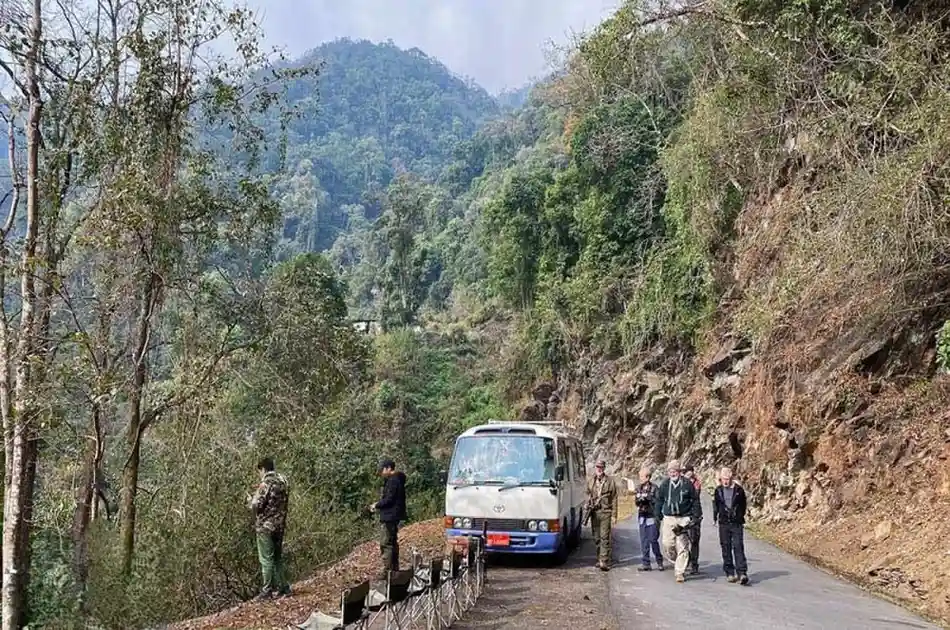
Bhutan's foothills, warm, forested and considerably lower in elevation than the high mountain passes most travelers picture, are home to a genuinely impressive concentration of hornbills. Of the 33 hornbill species found across Asia, four occur in Bhutan, and each one is distinctive enough that a confident identification is possible with just a few key field marks, provided you know what to look for and where to look.
This guide walks through all four species found in the country the features that separate one species from another and the regions where each is most reliably spotted.
Why Hornbills Matter in Bhutan's Forests
Hornbills aren't simply birds to check off a list. As large-bodied fruit eaters capable of swallowing whole fruits and later dispersing the seeds intact across wide areas of forest, they play a genuinely outsized role in maintaining the health and regeneration of the subtropical broadleaf forests they inhabit. Because they depend on mature trees with natural cavities for nesting and require large stretches of relatively undisturbed forest to find enough fruiting trees to sustain themselves, hornbill populations are also considered a reliable indicator of overall forest health. Where hornbills are still thriving the broader forest ecosystem is generally in good condition as well.
This is part of why Bhutan's southern belt running through districts like Zhemgang, Samdrup Jongkhar and the buffer zones around Royal Manas National Park carries conservation significance. It's some of the remaining habitat in the eastern Himalayas where all four of the region's hornbill species can still be found within a single relatively compact area.
Great Hornbill
The Great Hornbill, scientifically Buceros bicornis, is the largest of Bhutan's four hornbill species and among the largest hornbills in the world with a length that can exceed a meter. It's also the species most people picture when they imagine a hornbill in general, thanks to its size and prominent casque.
- Size: Among the Asian hornbills, males are noticeably larger than females.
- Casque: A large, prominent yellow-and-black casque sits atop the bill, one of the most distinctive features of the species and a key identifier even at a distance.
- Plumage: black body with a white neck, a black band across an otherwise white tail and pale wing markings visible in flight.
- Bill color: Bright yellow, often stained orange from preening with a naturally occurring pigment.
- Call: A far-carrying series of barking or honking calls often the first sign of the bird's presence before it's actually seen.
The Great Hornbill favors broadleaf forest at relatively low elevation and in Bhutan its most reliably encountered in the southern forests around Royal Manas National Park and the Zhemgang foothills, where fruiting fig trees provide a dependable food source throughout much of the year.
Rufous-necked Hornbill
The Rufous-necked Hornbill, Aceros nipalensis, is one of Bhutan's signature bird species and a major draw for birders visiting the country specifically to see it. Bhutan sits near the edge of this species' entire global range, making the country's population genuinely significant to the bird's overall conservation outlook.
- Size: A hornbill, typically 90 to 117 centimeters in length, among the bigger members of its family.
- Male coloring: A rufous or reddish-brown, head, neck, and underparts with glossy dark green-black wings and back and white tips on the tail and middle flight feathers.
- Female coloring: entirely black, distinguished from the male mainly by the same white tips on the tail and primary feathers without any rufous coloring on the head or neck.
- Facial skin: A pale ivory-colored bill with dark grooves paired with turquoise-blue orbital skin around the eye and a scarlet throat pouch marked with a dark blue line.
- Conservation status: Currently listed as Vulnerable by the IUCN with fewer than 10,000 adults estimated remaining in the wild globally and full legal protection in Bhutan under the Forest and Nature Conservation Act.
In Bhutan, this species is consistently found in the forests of Zhemgang along the old Zhemgang road toward Tingtibi and in Trongsa and Thrumshingla National Park, generally at elevations between 150 and 2,200 meters. These forests are also part of the route covered by the 7-day Bhutan Hornbill Adventure, where the Rufous-necked Hornbill is one of the main species to look for alongside the Great Hornbill.
Wreathed Hornbill
The Wreathed Hornbill, Rhyticeros undulatus, is somewhat less commonly reported in Bhutan than the Great and Rufous-necked Hornbills, generally favoring the lower foothill forests closer to the Indian border but it remains one of the country's four confirmed resident species.
- Male coloring: overall with a rufous crown, a white upper breast and face and a bare featherless yellow throat pouch that stands out clearly against the darker plumage.
- Female coloring: black, slightly smaller than the male with a blue rather than yellow throat pouch, a reliable way to distinguish the sexes at a glance.
- Bill and casque: A small, rigid casque compared to the Great Hornbill giving the species a somewhat sleeker silhouette in flight.
- Diet and behavior: An exclusively fruit-based diet favoring large fruits swallowed whole, which makes the species an important long-distance seed disperser within the forest ecosystems it inhabits.
This species favors evergreen foothill forest. Is most likely to be encountered in Bhutan's southern border regions, including parts of Royal Manas National Park, where its range overlaps with the country's other three hornbill species.
Oriental Pied Hornbill
The Oriental Pied Hornbill, Anthracoceros albirostris, is the smallest and generally the most frequently encountered of Bhutan's four hornbill species thanks in part to its considerably wider tolerance for human-modified landscapes compared to its three larger relatives.
- Size: smaller than the other three species, typically 55 to 60 centimeters in length.
- Plumage: Black head, neck, back and upper breast with a green sheen contrasted against a white belly, facial patch and white tips on the tail feathers.
- Casque: A whitish-yellow bill topped with a noticeably larger casque in males than in females, one of the more reliable ways to distinguish the sexes in the field.
- Behavior: More tolerant of human habitation than Bhutan's other hornbill species, sometimes found near villages, secondary forest and plantations rather than requiring untouched primary forest.
- Call: A repeated yapping or cackling call, often given socially between flock members.
Because of its adaptability, the Oriental Pied Hornbill has the distribution of Bhutan's four species with the forests around Samdrup Jongkhar in southeastern Bhutan considered a particularly reliable location alongside broader sightings across the southern subtropical belt.
Best Single Location: Royal Manas National Park
If there's one location in Bhutan where a birder has a chance of encountering all four hornbill species within a single trip it's Royal Manas National Park, a UNESCO-recognized protected area straddling Bhutan's southern border. The parks mix of broadleaf forest, warm and cool broadleaf zones and open grassland supports an exceptional 450 or more recorded bird species, including confirmed populations of the Great Rufous-necked, Wreathed and Oriental Pied Hornbills all within its boundaries.
The park's buffer zone around Tingtibi is also one of Bhutan's productive general birding areas and overlaps significantly with habitat for the critically endangered White-bellied Heron, making this stretch of central Bhutan genuinely one of the country's most rewarding regions for dedicated birders willing to spend a few days working through its forest trails and river edges.
Best Season for Hornbill Spotting
Hornbills across Bhutan generally breed between January and June with specific timing varying somewhat by species. Rufous-necked Hornbills nest primarily from March through June, favoring tall broad-trunked trees, while Oriental Pied Hornbills typically begin breeding in February, timed to coincide with the onset of seasonal rains and peak fruit availability. This breeding window tends to concentrate hornbill activity around known nest sites, making spring March through May the most productive season for reliable sightings across all four species.
Outside the breeding season, hornbills range widely in search of fruiting trees, which can make sightings less predictable but still genuinely possible with patience and local guidance since fruiting patterns shift throughout the year across different parts of the same forest.
Combining a Hornbill Trip With Birding
Because Bhutan's hornbill habitat sits within some of the country's richest general birding country, a dedicated hornbill trip pairs naturally with a broader birding itinerary. Travelers interested in Bhutan's high-altitude pheasant species may want to look into a guide to photographing the Himalayan Monal since many of the camera settings and fieldcraft principles, patience, appropriate shutter speed for a moving subject and quiet, low-disturbance positioning apply just as directly to photographing hornbills in dense forest conditions. For photographers who want to capture hornbills alongside a wider range of Bhutan's birdlife, the Bird Photography Tour in Bhutan brings together several habitats where different species can be photographed.
Frequently Asked Questions
How many hornbill species are found in Bhutan?
Four species: the Great Hornbill, Rufous-necked Hornbill, Wreathed Hornbill and Oriental Pied Hornbill.
Which is the hornbill species in Bhutan?
The Great Hornbill, which can exceed a meter in length and is easily identified by its yellow-and-black casque.
Which hornbill species is easiest to spot?
The Oriental Pied Hornbill, since it tolerates human-modified landscapes more readily than Bhutan's other three hornbill species and has the widest overall distribution in the country.
Where can I see all four hornbill species in one trip?
Royal Manas National Park in Bhutan, along with its buffer zone around Tingtibi is the most reliable single location, with confirmed populations of all four species recorded within the park.
Is the Rufous-necked Hornbill in danger?
It is currently listed as Vulnerable by the IUCN, with fewer than 10,000 adults thought to remain around the world and it has full legal protection in Bhutan.
What is the best time to see hornbills in Bhutan?
Spring, from March to May, is the time for seeing hornbills as it matches the breeding season for most of Bhutan's hornbill species.
Final Thoughts
Bhutan has four hornbill species, from the large crowned Great Hornbill to the more flexible Oriental Pied Hornbill, which provide a real challenge for birders who want to learn how to identify them. Learning the features for each- the shape and color of the casque the color of the throat pouch and the size of the body makes it easier to recognize them, and knowing where each species is likely to be found helps turn a quick uncertain look into a clear identification and turning a lucky look into a planned and successful experience.
For travelers who're ready to go beyond the more popular western valleys of Bhutan and into the warmer, thicker forests of the south all four species can still be found, especially if you choose the right time and work with a guide who knows the best parts of the forest, for each species.